Wednesday, 24 July 2013

A bird's eye view of the First World War

The cover: A Round Of Robins
A fascinating acount of the way the First World War affected a family of brothers who were scattered all over the world has just been published as an eBook. A Round of Robins is a collection of 'round-robin' letters which the brothers began writing to each other in 1904 and which continued for 40 years.

The correspondence was sent in notebooks by Nix, Frank, Ed, Charles, Herbert and Fred Kendall, who originally came from Blackheath in South London. They worked, respectively, as a doctor, architect, wool broker, civil servant, P&O manager and banker in England, South Africa, Australia, India and the Orient. 'The bird' (as it was referred to by the brothers) travelled roughly eastwards around the globe.

This first volume of letters covers the years 1904 to 1918 and particularly interesting are the accounts of the Great War written from different countries.

Initially, none of the brothers knew quite what to make of the conflict, except that it posed a threat to their communication: 'It seems an unnecessary shame to risk birdie on the billows with German ships – aye, and Zeppelins – dogging its wing flaps. But I will risk it soon, I think,' wrote Frank from Cape Town in September 1914.

The six Kendall brothers in 1886 with parents and sister
It didn't take long for more adventurous comments to take shape, as when Ed in Sidney made clear his opinion about soldiers Downunder:

'Australians as a race make excellent fighting men but lack disipline to a horrible degree and one can never be sure what they will do if left to themselves,' he declared.

The youngest brothers, Fred and Herbert, were twins and both worked in the Far East, one for the P&O shipping company, the other for the Hongkong and Shanghai Bank. Both were also eager to join the fighting, but only Herbert was 'lucky' enough to be released by his employer.

After a period of training in England, he was sent to the Western Front and wrote back some graphic accounts of life in the trenches. It all came to a dramatic end when he was sent home with shell shock. Charles, who had returned from India to work for the Admiralty, documented his brother's recovery: 'Herbert is going up for another Board today, so I shall probably be able to record the result in this bird. He is better, and as the electric treatment seems to be doing him good we hope he will be given another month of it.'

The oldest brother, Nix, had remained in England where he worked as a GP in Surrey, and his letters reflect Britain's stoical attitude during the Great War: 'We have distinctly heard the guns in Flanders lately when the wind and atmosphere are suitable. Rations are irksome but most people are getting used to doing without eating meat more than two days weekly, etc. We are lucky in being well off for veg and eggs. Cheese we get about once a week.'
'Rations are irksome'
Nicholas Kendall

This volume is a wonderfully entertaining account of the Great War from a kaleidoscope of  perspectives, it also describes exactly what life was like in Edwardian Britain and in the far-flung corners of the Empire. I have been lucky enough to use a lively extract in my own book Letters from the Trenches.

  • A Round of Robins is published by Eden Diaries and is available as an eBook from from www.edendiaries.co.uk. The price is £8.75 which includes daily extracts by email.


Tuesday, 2 July 2013

'The sky behind us lit up with a sheet of flame'

 
Artillery firing from behind
Canadian lines, over Vimy Ridge
The explosive power of warfare on the Western Front was often nothing short of spectacular, and some soldiers could not help but be amazed by what they saw, despite the slaughter and devastation that resulted.

'A most wonderful sight never to be forgotten,' wrote one Bristol infantryman. 'Bombardment started four o'clock in the morning...Terrific noise. Guns take us off our feet.' His diary entry was made in the spring of 1917 during the Battle of Arras, a major British offensive that provided plenty of pyrotechnic brilliance.
 
It began on April 9 with a battle to win control of the strategically important high ground at Vimy Ridge. The attack was preceded at 5.30am by an artillery barrage of high explosives and gas. Then, as the day broke, 30,000 Canadian troops climbed 'over the top' and advanced across No Man's Land. The fighting cost a huge number of lives, but they secured a famous victory.
 
The action was vividly described by a Canadian medical officer in a letter to his sweetheart: 'We had some breakfast at 4.30am and afterwards waited for zero hour which was 5.30am. It began to drizzle rain just before the fateful hour. Promptly on the minute the whole sky behind us lit up with a sheet of flame from hundreds of guns and our barrage opened with a noise like a terrible peal of thunder. There was a wonderful display of fireworks for miles along the German trenches caused by the bursting of our shells and Fritz's frantic SOS signals. It looked as though the sky were raining fire.'

Adrenalin was still high when he wrote to his cousin: 'It was a wonderful battle, the best show I have been in...For miles we could see the artillery barrage sweeping like a blizzard across the German position and the whole country behind seemingly covered with our advancing troops. The sight must have struck a chill into the German hearts.'

The offensive continued until May, and afterwards the devastation was clear to see. 'Came through Arras, what was once a beautiful town is now a mass of ruins,' wrote the Bristol infantryman in his diary. 'Piano's mirrors etc smashed up and nothing but debris in roadway.'

You can read plenty more from soldiers at the battlefront in my book 'Letters From The Trenches', which is being published next year.

The city of Arras in ruins


Monday, 17 June 2013

'My darling wife, I wish with all my heart this terrible war was over'

A WW1 postcard shows how easy
it was for men to fall prey to
loneliness in the trenches

Who should we feel most sorry for during the First World War? The men who fought and witnessed such horror that meant, even if they survived, they would never be the same again? Or women who were left to cope alone with the children and the shortages ... and the fear that they may never see their loved ones again?

Having spent some time researching the lives of the latter I've tended to sympathise with their plight perhaps a little more than the men, who at least played an active part in it all. What could be worse than being the passive party, worn out by domestic life and living in constant fear of the dreaded letter or telegram?

Then, unexpectedly, I came across a soldier's letter so moving that I realised it was pointless trying to decide who had the better deal during the Great War. There were no winners.

When Private Phillip Loxton, a volunteer soldier from Abertillery in South Wales, wrote to his wife in June 1915 the initial excitement of combat had worn off. He'd been ground down by trench life, had just seen a good friend killed, and in his loneliness he began to fear that his family might be forgetting about him.

Mr Darling Wife,
I had very near thought that you had forgot me for it is a full week since I heard from you last and I can assure you it have troubled me awful for I always looks out for a letter from you every three days, even it it is the same news over again. For then I think that you are thinking about me as I do you, for I can assure you that you and the childen are never out of my mind.
There are many nights that I can't put you and the children out of my sight, even if you are miles away from me I can see you all in life and I wish with all my heart that this terrible war was over. For I find it very lonely now that I have lost my chum, for he was a good old sort in his way, for it cut me up awful when I heard he was killed.

Tragically, Private Loxton would never see his wife and two young daughters again. He was killed in action in October 1915 and his body was never recovered. You can read more of his moving story and letters in my book Letters from the Trenches.

Monday, 27 May 2013

My new book brings old family back to life!

Regular readers may have noticed a longer-than-usual gap between posts recently, for which I apologise, but I do have a good reason - I've taken on another book! It's called 'Bristol In The Great War' and while I carry out research, I've put 'Letters From The Trenches' on hold until the autumn. Both books are due out next year.

Bristol is of particular interest to me, not only because I live near, but also because three quarters of my family were living in the city at the turn of the last century. My research into the social history of that period has proved a real eye-opener because it has allowed me to understand my forebears' lives in terms of what was going on at the time.

Great-grandfather No1 moved from the countryside
and established himself as a haulier
For example, my Great-grandfather No1 originally came from a family of agricultural workers in Wiltshire, but he abandoned the countryside in the 1880s and moved to Bristol to work in a glue factory, which always puzzled me.

I now realise that his move coincided with the industrialisation of the North Somerset coalfields at a time when the countryside was severely depressed. The mines attracted many new industries to the southern fringes of Bristol, and glue manufacturing was one of them. I'm pleased to say that in the following years Gg-No1 acquired a horse and established himself as a haulier in the St George district of Bristol.

Great-grandfather No2 (with pipe) and friends,
one of Bristol's many bootmakers
Great-grandfather No2 lived at Easton and worked as a bootmaker. I now know that he was one of many thousands of bootmakers in Edwardian Bristol because the city was a huge manufacturer of boots and shoes. His father, too, had been a shoemaker. However, his son did not follow in the family footsteps - he became a clerk instead. In the early 1900s, improved education and an expansion in city offices meant that white collar work was now an alternative to traditional manual work.

Great-grandfather No3 'at the wheel'
with his wife outside the Cooper's Arms
Great-grandfather No3 was a publican who ran the Cooper's Arms at Ashton Gate. His three sons all played for Bristol City Football Club which was (and still is) on the pub's doorstep. Mostly they played in the smaller competitions, but one brother had just started to make an appearance in the first team when the Great War broke out.

Quite how promising their footballing careers would have been I will never know because the Football league was brought to a halt by the war in 1915, with only regional and friendly matches permitted. The brothers all served in the army and although they survived the war, their names were never mentioned on team sheets again.

Great-grandfather No4,
a Liverpool lad
My Great-grandfather No4 was a northern lad and came from Liverpool, but there is still a Bristol connection through one of his sons, also a footballer, who joined Bristol City as captain in the 1926 and helped them win promotion in the league.

All this just goes to show that although family historians have never had so much information at their fingertips, a study of local and social history will help make sense of it all and bring it alive.

And finally...even though I've got two books to work on now, please let me reassure you that I will be continuing this blog as usual using letters and themes from the First World War - and now including a few from Bristol.

'Letters From The Trenches' and 'Bristol In The Great War' are being published by Pen and Sword Books; both are due out next year.

Friday, 10 May 2013

Warm wishes from a 'munitionette' in Scotland

Georgetown munition workers take a break for a snapshot

This week I received a delightful letter which was written in 1917 by a girl who worked in a Scottish munitions factory during the Great War. She was replying to a soldier in France who had got in touch after discovering a note from her in a box of shells she had packed. 'Munitionettes', as they were known, often tucked away notes to bring a smile to the faces of soldiers in the trenches.

There is plenty of interest in the letter, which was passed on to me by the soldier's daughter-in-law. There is also a little sadness and some nice humour too, all of which will be revealed in my book so I won't give any more away here!

It was interesting, though, to discover more about where the young lady worked. Her letter mentions 'Houston', west of Glasgow, but there is no record of a munitions factory ever having been there. It's likely she worked a short distance away at Filling Factory No 4, as it was officially called.

The site consisted of a shell-filling plant, a railway station and a 'township' of wooden huts to house the (mainly women) workers. It was later renamed Georgetown after a visit in 1915 by David Lloyd George who was then Minister of Munitions and later Prime Minister

At its peak, between December 1916 and August 1917, some 12,000 people were employed there filling shells with explosives to be shipped off to France. Georgetown did not manufacture its own explosives so these materials were delivered by rail, along with shell cases to be filled.

The factory had a lively social life with its own magazine, the Georgetown Gazette, which published the above photo of its workers. It closed in 1919 and today there is nothing left except the Georgetown Road which still runs past the site.

At work inside a Government WW1 shell-filling plant


Monday, 29 April 2013

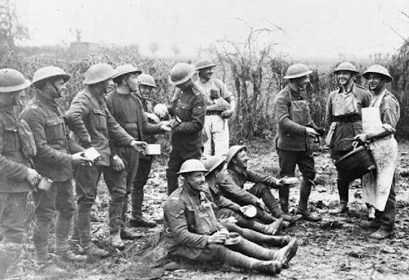
A nice cup of tea behind the lines


Everything stops for tea!
It's easy to think that life on the Western Front was one long round of battles, booming guns, mud and screaming shells, but there were lulls in the fighting and also periods of rest for soldiers away from the frontline when life was slightly easier.

In July 1918, Private Tom Fake made the most of his rest period and looked up an old friend from home who was billetted nearby. The account he sent his wife almost made it sound like peace time!

'I went and saw Mr Fare...it only took me about five minutes to find him, I got there in good time too, they had just made a good drop of tea so I had supper with him, bread and mutton. Well, I should say mutton and bread as the meat was most - about 1lb of breast. T'would have made four good chops.

'I got there about 7.30 and left about 10 o'clock or just after and it was dark as pitch. I felt in a bit of a fix as I could see no mark to get my place, but found it in about 10 minutes. My mate was at the top of the house ready in case I should shout, so as to give me the direction.'

While away from the fighting, Pte Fake took the opportunity to get his teeth sorted out - dental problems were a constant problem for servicemen - but his wife must have winced when she read about it:

'I told you in my last letter that I could not get my teeth taken out as we had no forceps. Before that letter had hardly left my hands Sgt Small came to tell me he had got a set that day, so last night I went to him and had two of the brutes out. I am not smoking much now, I have taken to cigarettes a lot lately as at times I have a job to hold the pipe between my teeth.'

By 1918, Pte Fake and his fellow soldiers were old hands at looking after themselves, especially when army rations were meagre:

'What money I have I spend on food, for instance sometimes we can get some potatoes. If about 30 of us put together we can have a good extra feed for about 1d or 2d each for one meal, you see I keep on learning how to make the best of hard times.'

Although there was still plenty of hard soldiering to be done during that final summer, hope was also in the air: 'I don't think it will last many more months,' wrote Pte Fake on 1st August 1918, 'I look at it like this. Germany must be getting played out, we are played out or getting on that way, and here is America [who joined the war in 1917] just starting...'

He was absolutely right. Three months later it was all over.

Saturday, 20 April 2013

An open letter from across the Atlantic

Get ready to Skype!
 
To the sixth grade students of Newton, New Hampshire in the US:
 
I hope you like the picture above, which was taken during our Skype session about the First World War. I had no idea that my face would be filling a wall! I hope the WW1 letters I was able to tell you about added a bit of colour to your studies - even if it was mud-coloured! - but how sad that so many were written by young men not much older than you.
 
Take my great-uncle Fred Wood, for example, a football-mad teenager from Bristol in England. He was just 17 when he joined up to fight in France, and his auntie obviously doted on him when she sent this message in December 1915: 'To Freddie, with all auntie's love and best wishes for a happy Christmas'. You can see the card below.
 
Auntie Pollie's card to her nephew Fred Wood
It was probably the first time Fred had been away from home at Christmas and, sadly, it was also his last. He was killed six months later on July 1, 1916 - the first day of the Battle of the Somme. This was the bloodiest day in the British Army's history, when 19,240 of its soldiers were killed, or died of their wounds. It's most likely that Fred was killed by a shell while advancing across No Man's Land. His body was never found.
 
Let's finish on a happier note. Thankyou to your teacher, Ms Woulfe, for organising our Skype session so efficiently - you can still read all about it on the post below. And good luck to you all, I'll let you know when my book, 'Letters from the Trenches', is published next year.


Top teacher! Nicole Woulfe