Monday, 27 May 2013

My new book brings old family back to life!

Regular readers may have noticed a longer-than-usual gap between posts recently, for which I apologise, but I do have a good reason - I've taken on another book! It's called 'Bristol In The Great War' and while I carry out research, I've put 'Letters From The Trenches' on hold until the autumn. Both books are due out next year.

Bristol is of particular interest to me, not only because I live near, but also because three quarters of my family were living in the city at the turn of the last century. My research into the social history of that period has proved a real eye-opener because it has allowed me to understand my forebears' lives in terms of what was going on at the time.

Great-grandfather No1 moved from the countryside
and established himself as a haulier
For example, my Great-grandfather No1 originally came from a family of agricultural workers in Wiltshire, but he abandoned the countryside in the 1880s and moved to Bristol to work in a glue factory, which always puzzled me.

I now realise that his move coincided with the industrialisation of the North Somerset coalfields at a time when the countryside was severely depressed. The mines attracted many new industries to the southern fringes of Bristol, and glue manufacturing was one of them. I'm pleased to say that in the following years Gg-No1 acquired a horse and established himself as a haulier in the St George district of Bristol.

Great-grandfather No2 (with pipe) and friends,
one of Bristol's many bootmakers
Great-grandfather No2 lived at Easton and worked as a bootmaker. I now know that he was one of many thousands of bootmakers in Edwardian Bristol because the city was a huge manufacturer of boots and shoes. His father, too, had been a shoemaker. However, his son did not follow in the family footsteps - he became a clerk instead. In the early 1900s, improved education and an expansion in city offices meant that white collar work was now an alternative to traditional manual work.

Great-grandfather No3 'at the wheel'
with his wife outside the Cooper's Arms
Great-grandfather No3 was a publican who ran the Cooper's Arms at Ashton Gate. His three sons all played for Bristol City Football Club which was (and still is) on the pub's doorstep. Mostly they played in the smaller competitions, but one brother had just started to make an appearance in the first team when the Great War broke out.

Quite how promising their footballing careers would have been I will never know because the Football league was brought to a halt by the war in 1915, with only regional and friendly matches permitted. The brothers all served in the army and although they survived the war, their names were never mentioned on team sheets again.

Great-grandfather No4,
a Liverpool lad
My Great-grandfather No4 was a northern lad and came from Liverpool, but there is still a Bristol connection through one of his sons, also a footballer, who joined Bristol City as captain in the 1926 and helped them win promotion in the league.

All this just goes to show that although family historians have never had so much information at their fingertips, a study of local and social history will help make sense of it all and bring it alive.

And finally...even though I've got two books to work on now, please let me reassure you that I will be continuing this blog as usual using letters and themes from the First World War - and now including a few from Bristol.

'Letters From The Trenches' and 'Bristol In The Great War' are being published by Pen and Sword Books; both are due out next year.

Friday, 10 May 2013

Warm wishes from a 'munitionette' in Scotland

Georgetown munition workers take a break for a snapshot

This week I received a delightful letter which was written in 1917 by a girl who worked in a Scottish munitions factory during the Great War. She was replying to a soldier in France who had got in touch after discovering a note from her in a box of shells she had packed. 'Munitionettes', as they were known, often tucked away notes to bring a smile to the faces of soldiers in the trenches.

There is plenty of interest in the letter, which was passed on to me by the soldier's daughter-in-law. There is also a little sadness and some nice humour too, all of which will be revealed in my book so I won't give any more away here!

It was interesting, though, to discover more about where the young lady worked. Her letter mentions 'Houston', west of Glasgow, but there is no record of a munitions factory ever having been there. It's likely she worked a short distance away at Filling Factory No 4, as it was officially called.

The site consisted of a shell-filling plant, a railway station and a 'township' of wooden huts to house the (mainly women) workers. It was later renamed Georgetown after a visit in 1915 by David Lloyd George who was then Minister of Munitions and later Prime Minister

At its peak, between December 1916 and August 1917, some 12,000 people were employed there filling shells with explosives to be shipped off to France. Georgetown did not manufacture its own explosives so these materials were delivered by rail, along with shell cases to be filled.

The factory had a lively social life with its own magazine, the Georgetown Gazette, which published the above photo of its workers. It closed in 1919 and today there is nothing left except the Georgetown Road which still runs past the site.

At work inside a Government WW1 shell-filling plant


Monday, 29 April 2013

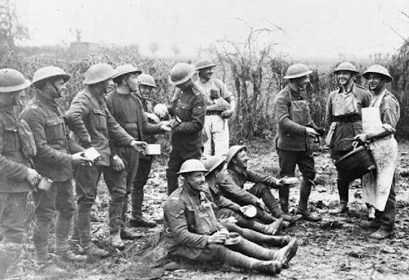
A nice cup of tea behind the lines


Everything stops for tea!
It's easy to think that life on the Western Front was one long round of battles, booming guns, mud and screaming shells, but there were lulls in the fighting and also periods of rest for soldiers away from the frontline when life was slightly easier.

In July 1918, Private Tom Fake made the most of his rest period and looked up an old friend from home who was billetted nearby. The account he sent his wife almost made it sound like peace time!

'I went and saw Mr Fare...it only took me about five minutes to find him, I got there in good time too, they had just made a good drop of tea so I had supper with him, bread and mutton. Well, I should say mutton and bread as the meat was most - about 1lb of breast. T'would have made four good chops.

'I got there about 7.30 and left about 10 o'clock or just after and it was dark as pitch. I felt in a bit of a fix as I could see no mark to get my place, but found it in about 10 minutes. My mate was at the top of the house ready in case I should shout, so as to give me the direction.'

While away from the fighting, Pte Fake took the opportunity to get his teeth sorted out - dental problems were a constant problem for servicemen - but his wife must have winced when she read about it:

'I told you in my last letter that I could not get my teeth taken out as we had no forceps. Before that letter had hardly left my hands Sgt Small came to tell me he had got a set that day, so last night I went to him and had two of the brutes out. I am not smoking much now, I have taken to cigarettes a lot lately as at times I have a job to hold the pipe between my teeth.'

By 1918, Pte Fake and his fellow soldiers were old hands at looking after themselves, especially when army rations were meagre:

'What money I have I spend on food, for instance sometimes we can get some potatoes. If about 30 of us put together we can have a good extra feed for about 1d or 2d each for one meal, you see I keep on learning how to make the best of hard times.'

Although there was still plenty of hard soldiering to be done during that final summer, hope was also in the air: 'I don't think it will last many more months,' wrote Pte Fake on 1st August 1918, 'I look at it like this. Germany must be getting played out, we are played out or getting on that way, and here is America [who joined the war in 1917] just starting...'

He was absolutely right. Three months later it was all over.

Saturday, 20 April 2013

An open letter from across the Atlantic

Get ready to Skype!
 
To the sixth grade students of Newton, New Hampshire in the US:
 
I hope you like the picture above, which was taken during our Skype session about the First World War. I had no idea that my face would be filling a wall! I hope the WW1 letters I was able to tell you about added a bit of colour to your studies - even if it was mud-coloured! - but how sad that so many were written by young men not much older than you.
 
Take my great-uncle Fred Wood, for example, a football-mad teenager from Bristol in England. He was just 17 when he joined up to fight in France, and his auntie obviously doted on him when she sent this message in December 1915: 'To Freddie, with all auntie's love and best wishes for a happy Christmas'. You can see the card below.
 
Auntie Pollie's card to her nephew Fred Wood
It was probably the first time Fred had been away from home at Christmas and, sadly, it was also his last. He was killed six months later on July 1, 1916 - the first day of the Battle of the Somme. This was the bloodiest day in the British Army's history, when 19,240 of its soldiers were killed, or died of their wounds. It's most likely that Fred was killed by a shell while advancing across No Man's Land. His body was never found.
 
Let's finish on a happier note. Thankyou to your teacher, Ms Woulfe, for organising our Skype session so efficiently - you can still read all about it on the post below. And good luck to you all, I'll let you know when my book, 'Letters from the Trenches', is published next year.


Top teacher! Nicole Woulfe

Wednesday, 10 April 2013

Rats and dead bodies in the classroom!

What did it really feel like to
be a soldier in the First World War?
(Postcard courtesy of David Clark)
When I think back to history at school, what do I remember? Two teachers. One droning on about Stone Age flints, the other instructing us to make notes from our  textbooks about Jethro Tull's seed drill while he nodded off at the front.

I'm sure they were both doing their best so I won't mention any names, but if only they'd used a bit of imagination history lessons would have been so much better. If only they'd been more like Miss Woulfe!

Nicole Woulfe is an American teacher from Newton, New Hampshire, who is currently teaching her class of 11 and 12-year-olds about the First World War. She got in touch, after hearing about my book on Twitter, to ask if I would be interested in having a chat with them on Skype about my soldiers' letters. I was more than happy to oblige.

The First World War didn't affect the United States in the same way as it did Britain, Europe, and countries of the former British Empire. As a result American students are far more familiar with their own Civil War. So what better way to make a distant conflict more interesting than through the eyes of those who lived through it?

Last week I spent a very stimulating afternoon (morning over there) talking to the students about the two topics they're covering: what life was like in the trenches, and the devastating influenza epidemic that followed the war. They were full of interesting questions, such as:

  • How long did it take to dig a trench?
  • Did soldiers eat rats?
  • What happened to the dead bodies?
  • Did soldiers get much sleep?
  • What effect did the influenze epidemic have at home?
  • Can you visit battlefield graveyards today?

Two stories in particular that I recounted made an impression on the class, said Miss Woulfe: 'They were most touched by the story of the fellow who was arrested for drunkenness in the trenches, even though he was just exhausted, and they were most shocked by the soldiers shaking the hand of an already dead and buried soldier.'
Both stories will be told in full in my book.

Full marks to Miss Woulfe for combining vivd primary sources (soldiers' letters) with new technology (Skype) to bring history alive. It was certainly an afternoon that I will remember.

  • Watch this space! I hope to post a picture of the students of Newton, New Hampshire, soon.

Friday, 22 March 2013

Search for the Manchester music man!

Star of the show, Bob Ainscow!
Does the name 'Ainscow' ring a bell with anyone? In particular a Bob Ainscow from Manchester who was a playwright and musician during the First World War? If so, Australian family historian Debbie Gower would be delighted to hear from you.

The Bob Ainscow she would like to track down, a relative of hers, was an attraction at the Patricroft Picture House, near Manchester (right) where he was billed as a 'descriptive vocalist' who would 'render patriotics songs by request'. 

He was also the uncle of Ernest Ainscow, an Australian soldier whose letters Debbie has sent me for my book. Ernest was born in Manchester in 1899 and emigrated to Australia nine years later with his family: father Richard, mother Eliza, two sisters and a younger brother. Ernest was close to his sister Lucretia and wrote letters to her when he joined up. Like their uncle, it seems they both loved music.

Lucretia and Ernest Ainscow in 1916
'I have got some bonzer music here for you,' he wrote from Brisbane, shortly before departing for Europe. 'Miss Manwaring got it for me last week and she is going to play it for me before I sent it, so as to see if I like it.' A few months later in England he sent back more letters that were full of praise for the shows he saw locally while at army training camp at Hurdcott in Wiltshire. You'll be able to read them in my book.

While in England Ernest also paid a visit to Manchester and may even have called in on another relative Debbie wants to track down, a cousin called Hercules.

In June1917 Ernest finally landed in France but tragically he didn't last long. Within two months he had died of wounds sustained in battle. There is now a creek and a road named after him in his Australian home town of Cairns, in Queensland.

If anyone has any information about Bob Ainscow or Hercules, please get in touch with me at jacwadsworth@hotmail.com and I shall put you in touch with Debbie Gower.

Friday, 8 March 2013

'Our worst enemies at present are lice'

Trench life: not much to smile about
Vermin were part of everyday life on the Western Front, and so too were unspeakable tiredness and death. However, the following letter extracts show that although by 1916 these things were still worthy of comment, they were hardly a cause for concern. The letters were written by Manchester 'Pal' Private Stanley Goodhead, whose correspondence will feature in several chapters of my book.

'It is good to be alive, in fact I am very much alive, so much so that I dare not take my clothes off when in billets for fear of them walking away. I am sorry our worst enemies at present are lice which thrive on nearly every one of us.

'It is not our fault but the conditions under which we live make it impossible to be clean, for a bath is a luxury which we hope to have when we get back to England.

'We have just been relieved out of the trenches after being in occupation for 12 days and it will take more than livestock to keep me awake tonight for I am nearly dead for want of undisturbed rest.

'There is very little news to tell you this time except that the Allimans have been busy again and made a hole in our numbers which I expect will be replaced by more draft men in a day or so.'

*****

'One of our lads after receiving his bread call last night humg it up on a beam so as to dodge the rats but they came in droves and made a raid on it and all that is left is the outside so we are sharing ours with him. When I was in bed last night quite a number walked over my head and body.'